-
I Used to Think Heritage Meant Frozen in Time
-
The 1815 Dinnerware Line Is a Signal, Not a Departure
-
Royal Doulton Santa Figurines: The Collector's Market Has Changed
-
Nativity Sets Are the Hardest Category to Inspect
-
Why a Crystal Vase Tests a Quality Eye
-
What Is a Suncatcher Ornament? (And Why It Matters Now)
-
Three Checks I Run on Every Royal Doulton Piece
-
Let's Talk About Resale Value Without the Hype
-
Bottom Line
Look, I'll be blunt. The biggest mistake buyers make with Royal Doulton is treating it as one of two things: either 'old-fashioned china for a sideboard' or 'an investment scheme with a backstamp.' Both are wrong. Royal Doulton is a quality standard, and that standard is evolving faster than most collectors want to admit.
I've spent 8 years as a quality compliance manager for a specialty giftware distributor. I review roughly 300 unique items a year—Royal Doulton dinnerware, figurines, crystal vases, nativity sets, and gift ornaments. In Q1 2024, I rejected about 11% of first-article samples across all brands for defects like off-register gilding and glaze pinholes. That number sounds harsh until you understand what poor quality actually costs. In 2023, we accepted a 'minor' glazing flaw on a large order, and it turned into a $22,000 reorder plus a delayed client launch. I don't accept 'minor' flaws anymore.
I Used to Think Heritage Meant Frozen in Time
The trigger event for me came in January 2024. We received a pre-production sample of a Royal Doulton 1815 dinnerware pattern. The bone china body was beautiful—creamy, translucent, well-balanced. But the gold band on one cup was off by about 0.4 mm. The supplier argued it was within industry tolerance. I rejected it anyway. I got the usual pushback: 'It's hand-finished; slight variation is part of the charm.'
Here's the thing: slight variation is normal. A 0.4 mm shift in a hand-painted floral detail is not a defect. But a 0.4 mm shift in a precision-gilded rim is different. You can see it when cups are stacked. The brand's history doesn't excuse sloppy execution; it demands better execution. That's what heritage should mean.
After I sent the sample back, I second-guessed myself. What if the delay cost us the order? It didn't. The replacement came back clean, and the launch ran better than expected. That was the moment I stopped thinking of heritage as a marketing label and started treating it as a performance standard.
The 1815 Dinnerware Line Is a Signal, Not a Departure
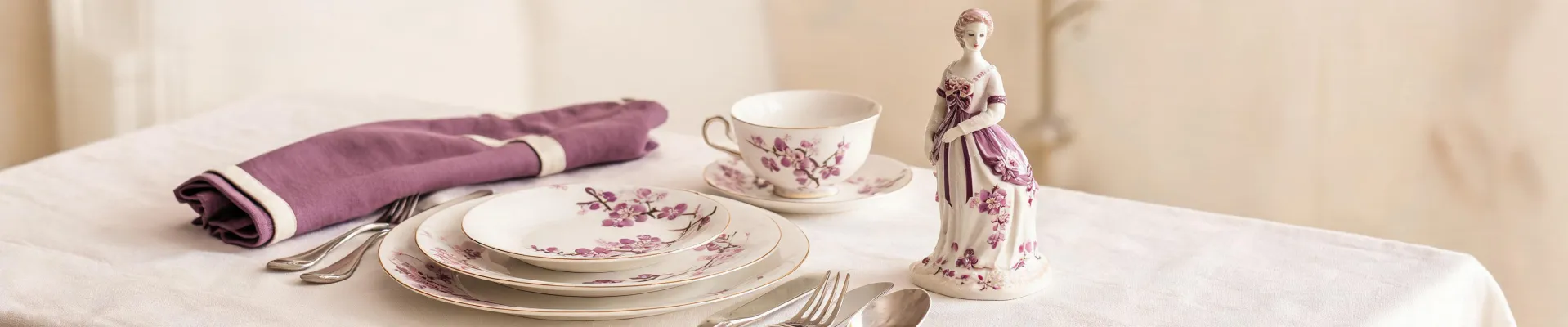
If you haven't looked at Royal Doulton 1815 dinnerware recently, the name suggests a museum piece. The reality is almost the opposite. The 1815 line uses fine bone china and traditional shapes, but the proportions are lighter and the finish is designed for regular use. It's basically the brand saying: 'You don't need a special occasion to use us.'
That is a big shift. For most of the 20th century, fine china was about ceremony. You brought out the good dinnerware for holidays, then put it back in the cabinet. The problem was that younger buyers stopped wanting that. They wanted tables that looked considered but didn't require an heirloom mindset. The 1815 collection answers that without ditching the craftsmanship.
Royal Doulton Santa Figurines: The Collector's Market Has Changed
One of the clearest examples of this shift is Royal Doulton Santa figurines. These are no longer just Christmas decorations. On the secondary market, they are some of the most searched Royal Doulton items. Annual releases, limited numbers, and different colourways have turned them into a collecting category of their own.
From a quality inspection perspective, Santa figurines are also a good test of the brand's consistency. The face is where the figurine stands or falls. If the beard texture is heavy-handed or the eyes are misaligned, the entire piece looks like a novelty shop reject. The best Royal Doulton Santa figurines have a quiet dignity: warm colours, clean gilding, and a backstamp that tells you exactly what you're holding.
I've rejected pieces where the gold buckle was patchy and pieces where the white glaze had a grey cast. Those aren't 'character.' Those are misses.
Nativity Sets Are the Hardest Category to Inspect
If you're thinking about a Royal Doulton nativity set, let me warn you: it's one of the hardest categories to quality-check. A nativity set isn't one piece; it's a system. You have the Holy Family, animals, shepherds, wise men, maybe a stable. Each element has to work on its own and as a group. The proportions have to feel right when they're arranged. If the donkey's ears are bigger than the sheep's, someone will notice.
Royal Doulton's nativity sets are interesting because they don't try to be modern. They keep a traditional, reverent look. But the materials have improved—better glazes, richer colours, more stable packaging. The fundamentals haven't changed: the pieces are still moulded, finished, and fired with care. What has changed is that the market now expects them to survive years of seasonal setup and storage.
That's where my own process gap taught me a lesson. We didn't have a formal photography process for inbound giftware until 2022. Then a client claimed a porcelain donkey arrived damaged. We couldn't prove it hadn't. We paid the claim. Now every Royal Doulton nativity set gets photographed from three angles before it goes out. It costs an extra 90 seconds per set, and it has saved us thousands.
Why a Crystal Vase Tests a Quality Eye
Porcelain hides some flaws. Crystal does the opposite. A crystal vase is one of the most unforgiving products I inspect. A flaw in the glass catches the light and multiplies. I check four things on every crystal vase: the rim symmetry, the base polish, the clarity or brilliance, and the sound when tapped. Yes, I tap it. A good crystal vase has a nice ring. A chipped piece thuds.
There's also a terminology problem in the wider market. 'Crystal' is used loosely. Genuine crystal is glass with a higher refractive index, usually from lead oxide or alternative metal oxides. Both lead crystal and lead-free crystal can be excellent. The red flag is when a product is labelled 'crystal vase' with no specification at all. That usually means the maker is avoiding the comparison. Royal Doulton's crystal pieces—vases, bowls, and toasting glasses—have a clear enough spec that I don't need to guess.
For a corporate gift, a crystal vase is a safe but serious choice. It's not as demanding as a full dinner set. But if you're buying for a client, inspect the bottom, not just the top. Poor base finishing is a sign the maker skipped the boring part of quality.
What Is a Suncatcher Ornament? (And Why It Matters Now)
Now let's address a keyword that gets a surprising amount of search traffic: what is a suncatcher ornament?
A suncatcher ornament is a small decorative object, usually made of glass or crystal, designed to hang in a window. It captures sunlight and casts little rainbows or flecks of light into the room. They were big in the 1970s, then fell out of fashion, then quietly came back as people started making 'sunlight corners' at home. The same impulse that drives people to buy a crystal vase—bringing sparkle into daily life—drives the suncatcher market.
Is a suncatcher a Royal Doulton thing? Not specifically. It's a generic category, and plenty of makers produce them. But the rise of suncatchers matters for Royal Doulton buyers because it signals a broader shift: people want crystal objects that do something more than sit on a shelf. They want light, movement, and small moments of beauty. That's why the brand's crystal vases, ornaments, and gift pieces are more relevant than the 'fine china as museum display' model.
Three Checks I Run on Every Royal Doulton Piece
I don't trust any inspection until I've checked three things. These apply to a Royal Doulton 1815 dinner plate, a Santa figurine, or a nativity set.
- The backstamp story. The backstamp tells you era and origin. A crisp 'Royal Doulton England' mark from the mid-20th century has a different value context than a modern 'Royal Doulton' stamp. That matters if you're collecting; it matters less if you're using it daily, but it should always be legible.
- The gold and the glaze. Look for clean-edged gilding and an even glaze. Slight pooling in a recessed detail is okay. Patchiness on a flat surface is not.
- The face. For any figurine or nativity figure, the face is where quality lives. If the painting is flat or the eyes are asymmetrical, the piece fails. There's no excuse for a face that looks wrong.
These fundamentals haven't changed in 200 years. What has changed is how pieces are displayed. People photograph them, put them on open shelves with plants and books, and use them in styled scenes. That means quality issues that used to be hidden in a cabinet are now visible to everyone.
Let's Talk About Resale Value Without the Hype
I get asked about resale value a lot. Senior managers, corporate buyers, and collectors all want to know if a Royal Doulton purchase will go up in value. Here's my honest answer: the resale value is earned, not guaranteed. No reputable company should promise investment appreciation. Anyone who does is selling a story, not a product.
That said, some categories have become genuinely collectible. Royal Doulton Santa figurines, rare nativity sets, and certain crystal vases can carry strong auction prices. Based on public auction records I've tracked through Q4 2024, the discontinued Santa figurines in original boxes outperform most current releases. Why? Scarcity, condition, and a backstory. The same logic applies to old nativity sets in good condition. But those are outcomes, not purchase guarantees.
If you buy Royal Doulton because you love it, keep the packaging, and handle it with care, you'll be in a good position if you ever want to sell. If you buy it hoping for a 20% return, you're in the wrong product category.
Bottom Line
What was best practice in 2020—or 1980—does not fully apply in 2025. The industry has changed. Formal dining has declined. Digital display is everywhere. Buying decisions are faster and more aesthetic. To be fair, some people will always want the old ceremony. That's fine. But the fundamentals of Royal Doulton's appeal haven't changed: honest materials, clean lines, skilled finishing, and a brand that tells you something about its past without being trapped by it.
My advice as someone who has held hundreds of these pieces under a light: buy the Royal Doulton 1815 dinnerware for everyday meals. Buy a Santa figurine for the tradition. Buy a crystal vase because it makes a table feel complete. Buy a nativity set because it grounds the season. And if you see a well-made suncatcher ornament, don't dismiss it as kitsch. It's just the latest version of what Royal Doulton has always been about—putting refined light and form into ordinary life.
Heritage doesn't mean standing still. It means holding a standard while the world moves. That's what I think when I sign off on a Royal Doulton piece. And that's why I'll keep rejecting the ones that don't meet the mark.