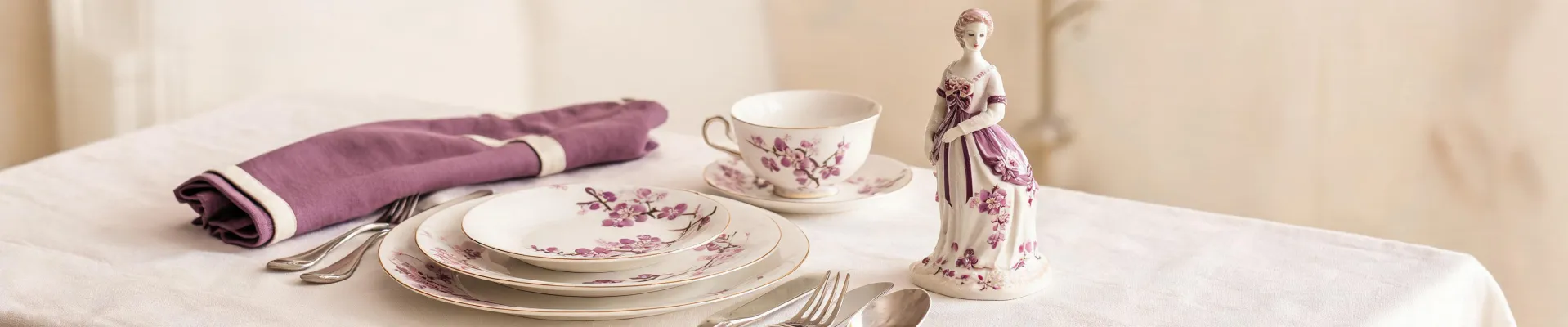
I've handled corporate gift orders for six years, which means I've shipped thousands of dollars worth of premium brands, personalized leather goods, engraved desk pieces—and one regrettable robot vacuum experiment. But the mistake that taught me the most, and cost me roughly $3,200, involved Royal Doulton.
It happened in November 2024. We'd just closed a major contract, and leadership wanted gifts for our top 20 clients. My manager put it simply: "Make it memorable."
I chose Royal Doulton without much hesitation. Two hundred years of heritage. Bone china craftsmanship. Royal warrants. The safest premium choice in the room—the kind of brand that says "we did our homework" even when you haven't. I placed the order before the week ended.
The order that looked right on paper
Here's a confession: I'm not an antiques person. I don't own a porcelain figurine, I can't name a single Royal Doulton designer, and before this order, I couldn't tell you what an HN number was. My job was logistics—getting the right gifts to the right people at the right time. I'd always relied on the vendor for the expertise part.
That's why Royal Doulton miniature figurines felt like such a win. Same brand name as the full-size pieces, same aesthetic, but at a price that let me buy one for each of the fifteen accounts on my list. A no-brainer, I told myself. Same heritage, smaller footprint, everyone wins.
The numbers were beautiful. Every spreadsheet row pointed to "approved." And yet something felt slightly off the moment I clicked "submit order"—not loud enough to stop me, but enough to notice. The thing my gut was picking up on? Presence. You can't put it in a spreadsheet, but you can absolutely feel its absence when the boxes arrive.
The moment the mistake surfaced
The boxes came on a Thursday. I opened the first one and felt an odd, hollow sensation. The miniature figurines weren't bad, exactly—they were just... small. Cute the way a trinket is cute. I set one on my desk, then on my colleague Diane's desk, then held it up against a coffee mug to measure its "presence." It didn't measure well.
Diane, who collects antiques as a hobby, picked one up and turned it over. "No HN number on the base," she said quietly.
"Is that important?" I asked.
That question sent me down a research rabbit hole at 8pm on a Thursday, looking for a straight answer to the question, what are Royal Doulton figurines worth, and whether I'd just spent serious money on the wrong thing.
What Royal Doulton figurines are actually worth
I won't pretend to be an appraiser, but here's what I learned from dealer listings, collector forums, and a few gracious emails to people who know this world far better than I do.
A Royal Doulton figurine's value comes down to four things:
- HN number — a registration number, introduced in 1913, tied to each design. "HN" honors Harry Nixon, the artist behind the earliest registrations. Pre-war designs and early HN numbers are where serious value lives.
- Condition — chips, cracks, faded paint, or any restoration can cut value in half or worse. Collectors pay for original, un-tampered condition.
- Rarity — shorter production runs mean harder to find. Designs produced for decades are common enough that they don't command a premium.
- Desirability — some figurines simply have more devoted followings. Character studies from the 1920s–1940s, especially pieces by designers like Leslie Harradine, hold up well in the market.
A typical post-war figurine in good condition might sell in the $100 to $250 range. A rarer pre-war piece in excellent condition can reach $800 to $2,000. At the top end, certain Royal Doulton figurines have fetched five figures at auction. The gap between "nice decorative piece" and "collector's item" is enormous—and I bought firmly from the first category while assuming I was in the second.
The miniature figurines weren't worthless. But for the high-level clients I was trying to impress, they read as a small gesture, not a meaningful one. That's a gap the spreadsheet never showed me.
The crystal vase and the tulip question
There was one piece in the order I didn't regret: a Royal Doulton crystal vase, chosen for our largest client. It arrived safely, looked stunning on the conference table, and felt substantial in a way that made the miniatures feel even smaller sitting beside it.
Diane asked, "Do you know when to cut tulips for a vase?"
I didn't. I thought you just cut the stems and put them in water—which, in fairness, is the tulip equivalent of wearing a tuxedo with sneakers. It works physically, but the details are where the grace lives.
Turns out tulips should be cut in the early morning, when stems are fully hydrated. You use a clean vase with cool water, cut the stems at an angle, and strip any leaves that would sit below the waterline. Then the beautiful part: tulips keep growing after they're cut. They bend toward light, which is why a tulip arrangement looks a little different every day.
Why does this belong in a Royal Doulton article? Because the care you put into the details is the actual gift. A crystal vase says "you're valuable." Showing you've thought about how it will be used says "we paid attention." That's the difference between a premium product and a premium experience—and it's the same reason a collector's eyes light up at an HN number stamp. The number is tiny. The meaning is not.
The honest math
Fifteen Royal Doulton miniature figurines cost $1,800. The crystal vase added $420. The fix—six full-size figurines for our six priority accounts, plus rush handling—came to about $2,000. All in, roughly $4,200, with $3,200 parked safely in the "lessons learned" column.
The frustrating part is that it was completely avoidable. You'd think, after six years of coordinating gifts, I'd know to ask whether the product and the purpose actually matched. But I was so eager to look prepared that I skipped the preparation that mattered.
What the mistake taught me about expertise
The vendor who sold me the miniatures did say something I'll never forget: "Miniatures are lovely, but they're different from full-size collectible figures. If you want pieces with investment-grade potential, I'd recommend talking to a Royal Doulton specialist before we finalize."
I heard him. I didn't listen. That's not his fault—it's mine. He knew his boundary. He told me exactly where his expertise ended and where a specialist's began. The price of me not knowing my own boundaries was $3,200.
In my opinion, the vendors who say "this isn't my area, here's who can help you better" are the ones worth keeping. The generalists who claim to do everything end up doing nothing deeply. That goes for vendors, and honestly, it goes for those of us buying corporate gifts too.
If you're buying Royal Doulton figurines as corporate gifts
- Ask what the piece says before you ask what it costs. Miniature figurines are fine, friendly gifts for a casual thank you. They are not statement pieces for VIP accounts.
- Look for the HN number. It's a tiny stamp with outsized meaning to the people who collect Royal Doulton. A documented piece shows you bought from someone who knows their stock.
- Consult a specialist. There are dealers who've spent decades with this brand. They know which designs are loved, which are overpriced, and which are right for your person. That's their lane. Let them drive.
And if you're gifting a crystal vase, take the two minutes to learn when to cut tulips for it. The details are what people remember.
Take it from someone who paid $3,200 to learn that lesson.