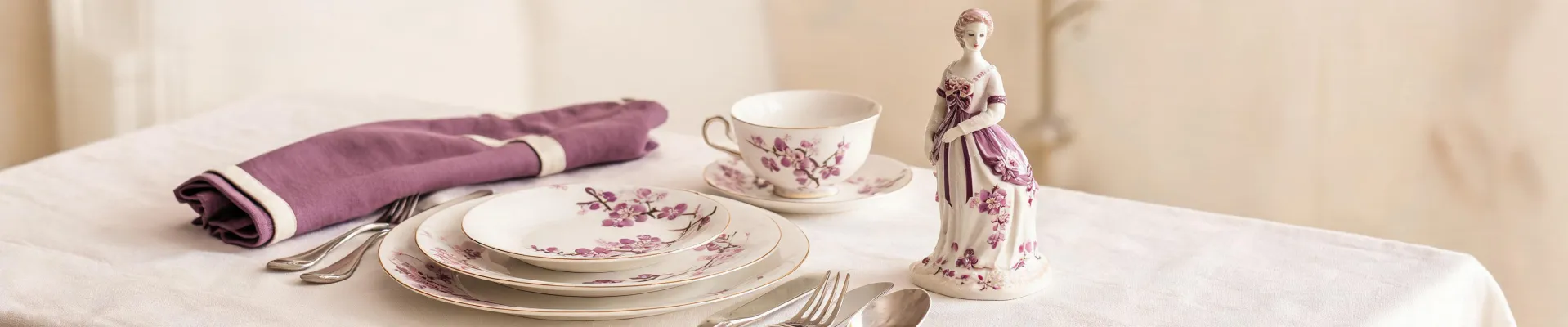
The question "Is Royal Doulton worth it?" comes up constantly—and the truthful answer is: it depends on which of three buyers you are. I've spent six years managing procurement and corporate gifting for a mid-sized tech company, overseeing a budget that runs around $180,000 a year. I've ordered Royal Doulton for client dinners, shipped it to partners in three countries, and tracked its resale market long enough to develop opinions I wasn't asked for.
Here's the thing: a single "yes" or "no" answer doesn't work for Royal Doulton. The calculus changes depending on whether you're a collector, a corporate buyer, or someone buying for a special occasion.
Scenario A: The Collector's Purchase
When you're buying for your own collection, you are optimizing for two things: what you'll enjoy living with, and what might become more desirable over time. These don't always align, and the gap between them is where buyers overspend.
Royal Doulton dinnerware patterns are a useful case study. Old Country Roses is the most recognized pattern out there, but collector interest runs deeper for discontinued lines such as Sarabande and Gramercy. I've tracked resale listings for years, checking what patterns actually sell versus what they simply list for. Discontinued patterns hold value better than new ones, provided the pieces have original backstamps. But list prices are idle dreams—a 50-piece set can sit listed at $1,800 and sell for $1,100 after four months on the market. If you love the pattern, that doesn't matter. If you're buying to flip, the markup is thinner than it looks.
Figurines come next, with higher stakes. Search for rare Royal Doulton figurines and the Negligee series will surface quickly. Produced mostly in the 1930s, these pieces were racy for their era—sometimes literally kept behind closed cabinet doors. That combination of scarcity and taboo history makes them among the most hunted Royal Doulton items today.
Here's where I admit a costly mistake. In 2022, at a regional antiques fair, I found a near-mint Negligee piece listed at $950. My tracking spreadsheet said comparable pieces averaged $700 to $800 at auction, so I walked away to compare prices. The piece was gone the next morning. A similar one went up on a resale site two months later for $1,400.
I still kick myself for that. Not because I should overpay for everything, but because the average sale price is a lagging indicator for rare goods. When you see a verified authentic piece at a fair market price, the opportunity has a shelf life. Waiting for a better deal is how you lose the piece entirely. This is the time-certainty premium in its most personal form—the cost of hesitation is losing the thing altogether.
Vases, meanwhile, are the underappreciated practical option. Royal Doulton crystal vases typically retail below high-end figurines, ship without drama, and sit comfortably in any decor. From a total-ownership-cost view, they're superior for new collectors: less fragile, less condition-sensitive, and less volatile on resale. That's where I'd steer anyone starting out.
Scenario B: The Corporate Gift Buyer
Corporate gifting is where the certainty premium turns from theory into cost. I learned this in October 2023.
I'd ordered 18 Royal Doulton gift boxes for a client appreciation dinner, and the webpage said 5–7 business days for delivery. The boxes arrived on day nine, two days after the event. We spent roughly 30% more on last-minute replacements from local retail shops, and the carefully selected gifts sat in the office lobby until we repurposed them for another event.
My fault. Expedited shipping was offered at checkout, and I skipped it to save the fee. The fee—which I'd balked at—was maybe 2% of the total order. The emergency replacements cost thirty percent more. That's what I mean by certainty being worth a premium. A rush fee doesn't buy speed, it buys assurance; when there's a hard date, assurance is the product.
We now ask every vendor three questions before ordering: What is the exact ship date? Is delivery trackable? What's the penalty for late arrival? If they can't answer in one sentence, we move on. That habit has prevented at least two similar failures since.
For what to send, my experience spans enough orders to know a few patterns:
- Vases for senior clients. A crystal vase lands well across cultures and settings. A figurine might be too personal or culturally specific.
- Build sets for mid-tier budgets. A small ornament alone can feel token. Combine it with a premium scented candle and you have a considered gift package for roughly $150–$200.
- Don't buy tier-1 brand, tier-3 item. If the budget won't stretch to a meaningful Royal Doulton piece, choose a better item from a different brand. A tiny emblem of prestige is worse than a substantial gift without the big name.
A pragmatic tip: keep a pre-approved gift list segmented by price bracket, with shipping costs included. I built one after my repeated mistakes and it now takes me fifteen minutes, not two days, to close a gift order.
Scenario C: The Special Occasion Buyer
Weddings, retirements, anniversaries—the goal is different again. You're not storing value or projecting a company's brand. You're trying to make a person feel understood.
Start by asking whether Royal Doulton fits the recipient's actual life. Prestige is not a one-size-fits-all gift. Consider the crafters in your life. If someone spends weekends on diamond painting, you might be wondering what are drills in diamond painting—they're the tiny resin rhinestones placed one at a time to create a shimmering mosaic. That person would likely be more moved by a high-quality craft kit than by a porcelain ornament they'll feel obligated to display.
The registry angle matters too. Many couples register for Royal Doulton patterns without realizing the full range available. They pick a dinner service set; they don't know the same pattern includes serveware, teaware, and ornament pieces. If you're buying off a registry, look at what's missing rather than adding a third teapot.
But when the recipient does appreciate fine porcelain, the scenario rules are straightforward:
- Choose dinnerware patterns that fit the person's actual use. Full 45-piece sets feel impressive but often sit in cabinets. A tea set or buffet set gets used, and gets used loudly.
- A vase is almost always a safe wedding gift. Couples rarely register for vases, so one feels specially chosen, not picked off a list.
- If you know the collector and stumble on a rare missing piece—a Negligee figure they've been hunting, for example—buy it immediately at a fair price. There is no "should I compare more?" in that moment. There's only "will I regret losing it?"
How to Know Which Scenario You're In
If you're still unsure, run through these four questions:
- Who is the beneficiary? Yourself, your employer, or the recipient? The optimization target differs for each.
- What will the item actually do? Daily use, display, or a long-term collection? That changes which patterns and piece types make sense.
- What's the deadline and what does missing it cost? Write it down. Don't estimate it.
- What happens if you're wrong? Discontinued patterns and rare figurines are hard to resell for what you paid. Know your downside before you commit.
To be fair, there are cases where the answer is plain no. If nobody involved has real appreciation for the piece, if the purchase is driven by vague prestige-seeking, or if the deadline isn't factored into your planning, the money is better spent elsewhere. But when it aligns—a collector finds a rarity, a client receives a thoughtful gift on schedule, or a friend gets a set they'll use every morning—the premium price buys something real. The question "Is Royal Doulton worth it?" isn't really about the brand. It's about the gap between price and value in a specific context. Get the scenario right, and that gap closes.